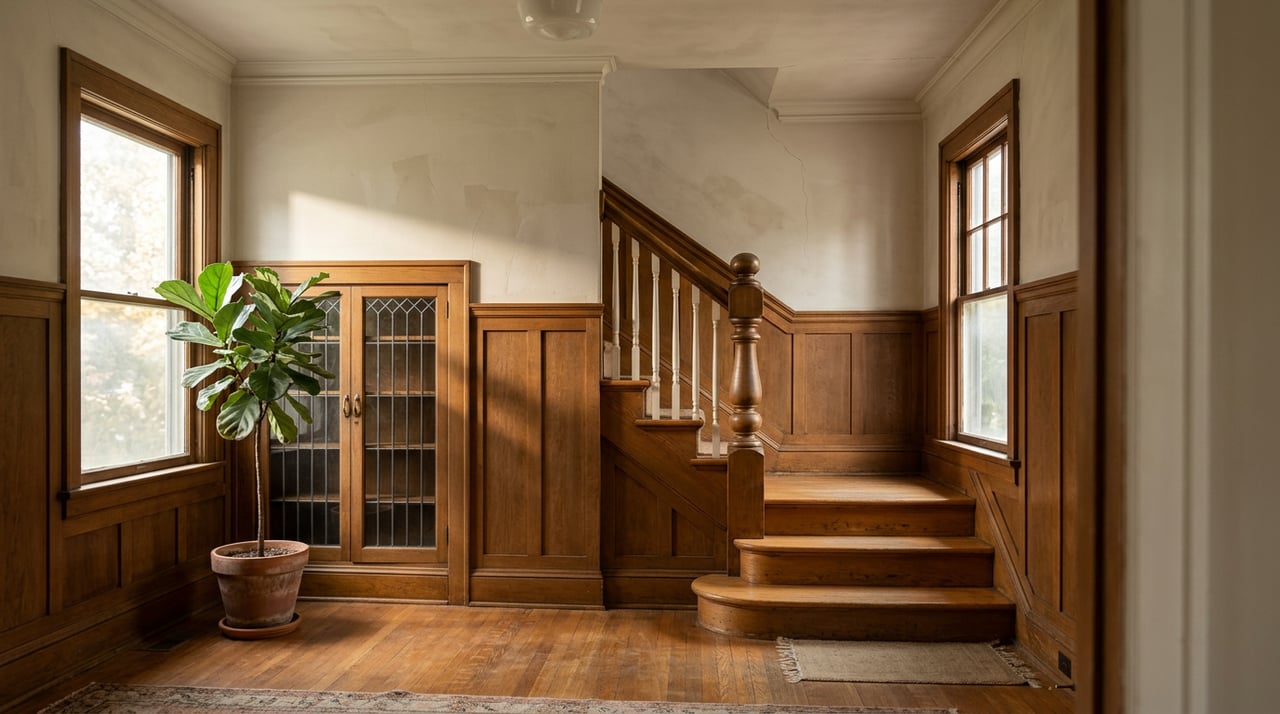
Two houses sit two miles apart in Des Moines. Both are pushing a century old. Both come back from inspection with a flagged window sash rotting at the sill, the kind of finding that shows up in nearly every prewar home in this city. The buyer in Beaverdale gets three contractor bids by the end of the week and picks one. The buyer in Sherman Hill has to wait on a city commission before a contractor can even pull a permit to start.
Same finding. Same age of house. Completely different repair clock. If you're buying or selling in one of Des Moines' classic close-in neighborhoods this year, that gap is the thing worth understanding before you write or accept an offer, not after.
The Findings That Show Up No Matter Which Street You're On
Beaverdale, Sherman Hill, Drake, and Highland Park share a housing stock built mostly before 1970, and that shared age produces a predictable set of inspection findings regardless of which street you're standing on. Knob-and-tube or early cloth-insulated wiring still turns up in homes built before 1970 and can complicate insurance placement even when it's functioning fine. Original cast iron or galvanized drain lines are approaching or past their practical service life in a lot of these houses, which is why a sewer scope is worth the extra line item on your inspection invoice.
Foundations carry their own regional story. Polk County sits on the Des Moines Lobe, where 45 to 60 feet of glacial till, an uneven mix of clay, sand, gravel, and buried cobbles, lies under nearly everything. That till behaves differently block by block, which is part of why two basements on the same street can show completely different crack patterns. Add a 42-inch frost depth and a spring snowmelt that pushes the seasonal water table to within two or three feet of most basement slabs, and you get the horizontal cracking, bowing block walls, and cove-joint seepage that foundation contractors like JLB Foundation and Waterproofing see constantly in Beaverdale, Sherman Hill, and Drake. Stabilization work in Polk County typically runs $3,000 to $15,000, with waterproofing landing in the $3,000 to $12,000 range depending on scope.
Then there's radon. Iowa sits in EPA Zone 1, the highest risk tier, and Polk County is no exception. The Iowa Department of Health and Human Services puts the statewide average indoor radon level at 8.5 picocuries per liter, against a national average of 1.3, and more than 70 percent of tested Iowa homes come back above the 4.0 pCi/L action level. A standard mitigation system runs $800 to $2,500. None of this is neighborhood-specific. It's era-specific, and it shows up on inspection reports from the East Side to Highland Park with roughly the same frequency.
The Distinction That Actually Changes Your Repair Timeline
Here's where the two houses stop looking alike. Sherman Hill is one of Iowa's best-preserved late 19th century neighborhoods, sitting just west of the state capitol, and it carries two separate designations that people routinely confuse. It's listed on the National Register of Historic Places, which by itself changes almost nothing about what an owner can do to a house. A National Register listing alone doesn't require anyone's permission to replace siding or swap out a window. What it does unlock is access to Iowa's State Historic Preservation Tax Credit, worth up to 25 percent of qualified rehabilitation costs on contributing properties.
Sherman Hill also carries a second, separate designation: it's a locally designated historic district, one of a small number in the city. That distinction is the one with teeth. Under city rules, any exterior alteration in a local historic district, additions, siding replacement, window changes, porch work, requires a Certificate of Appropriateness from the Des Moines Historic Preservation Commission before a building permit can even be issued. Interior work is exempt. Exterior work is not.
This isn't a theoretical rule sitting quietly in the code. In October 2025, a proposed new home on a long-vacant Sherman Hill lot drew pushback from neighbors after the Historic Preservation Commission approved its design, partly because the design read as out of step with the neighborhood's Victorian character, and partly because a local real estate agent who sold the lot also sat on the commission and voted on the approval without abstaining. Axios Des Moines covered the dispute in detail, including the city planning department's explanation that design guidelines for brand-new construction differ from guidelines for renovating an existing historic home, which are built around preserving as much original material as possible. The point isn't the drama. It's that the review process is active, contested, and genuinely shapes what gets approved and how fast.
Beaverdale and Drake don't carry that same local district overlay, at least not based on current city and neighborhood association guidance. A window repair flagged on a Beaverdale inspection report goes straight to permit. The identical finding on a Sherman Hill inspection report goes through commission review first.
| Neighborhood | Typical build era | Common foundation type | Local historic district (COA required for exterior work) |
|---|---|---|---|
| Beaverdale | 1920s-1950s brick | Stone or concrete block basement | No |
| Sherman Hill | 1870s-1910s Victorian | Stone or rubble foundation | Yes |
| Drake | 1920s-1940s bungalow | Block or stone, era-typical | No |
What the Gap Actually Costs You
Radon mitigation doesn't care what neighborhood you're in. It's an interior-adjacent system, a sub-slab depressurization setup that vents through the house, and it doesn't touch the exterior envelope. A contractor can usually schedule and install it within days of a test coming back elevated, no matter which of these four neighborhoods the house sits in.
Exterior masonry and window repairs are a different story in Sherman Hill. A homeowner three blocks outside the district boundary calls a contractor, gets a bid, and schedules the work. A homeowner inside it has to build in time for a Certificate of Appropriateness review before that same contractor can pull a permit. If you're negotiating a repair credit or a seller-complete-before-closing clause on an inspection finding that touches the exterior in Sherman Hill, that review step is a real variable in your timeline, not a formality to wave off.
If your inspection report flags exterior work in Sherman Hill, don't structure your closing date around a contractor's calendar alone. Structure it around the commission's calendar too.
Reading the Market Right Now
As of July 2026, the Des Moines metro area, Polk, Dallas, and Warren counties combined, closed 1,022 sales at an average price of $370,000 against 3,480 active listings, according to Des Moines Area Association of Realtors data. That works out to roughly 3.4 months of inventory metro-wide, which sits inside the balanced range. Broken out by price band, homes under $350,000, where most of the bungalows and Victorian-era homes in Beaverdale, Sherman Hill, and Drake tend to land, are moving fastest at around 3.0 months of inventory, with 61 percent of July closings finding a buyer within 30 days.
That's competitive, but it isn't a frenzy. A market where more than a third of closings still take longer than a month gives buyers real room to ask for what they actually need, whether that's a longer inspection contingency period to get a Certificate of Appropriateness estimate from a contractor, or a repair credit sized to reflect that Sherman Hill timeline rather than a generic three-week turnaround.
What This Means If You're Buying or Selling Here
- If you're touring in Sherman Hill, ask your agent to confirm whether the specific address sits inside the local historic district boundary, not just the National Register boundary. They aren't the same map.
- If an inspection flags exterior masonry, siding, or window work in a local historic district, get a rough sense of the Certificate of Appropriateness process before you finalize a repair timeline in your offer.
- If you're selling in Beaverdale, Sherman Hill, or Drake, get ahead of the predictable findings, wiring age, foundation type, and radon, before a buyer's inspector does. A pre-listing radon test alone is cheap insurance against a surprise that stalls a contract.
- If you're comparing homes across these neighborhoods on price alone, remember that identical repair line items on two inspection reports can carry very different timelines depending on which side of a historic district line the house sits.
Frequently Asked Questions
Does a National Register listing by itself restrict what I can do to my house? No. A National Register listing recognizes historic significance and can unlock tax credits, but it doesn't require government approval for exterior changes. Only a separate local historic district designation, which Sherman Hill also carries, triggers that requirement.
Do interior renovations in Sherman Hill need a Certificate of Appropriateness? No. City guidance is clear that interior changes are exempt from historic review. The requirement applies specifically to exterior modifications visible from the street.
Is radon testing required by law during an Iowa home sale? There's no state law requiring radon testing or mitigation as part of a transaction, but Iowa law does require sellers to disclose any known radon test results, and both parties must acknowledge receiving the state's radon fact sheet as part of the standard disclosure process.
If you're weighing a purchase in one of these neighborhoods and want a read on what a specific address's inspection findings and district status actually mean for your timeline, Parker Crispin can walk through it with you. Schedule a consultation before you write the offer, not after the inspection comes back.